
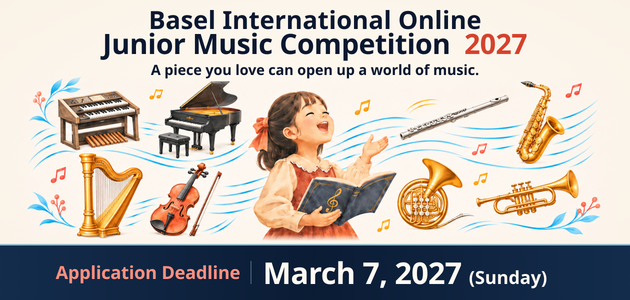
Basel International Online Junior Music Competition 2027ENTRY ← click How to enter Application deadline — Sunday, March 7, 2027, at 23:59 (Japan Standard Time) |
Competition Guidelines
About the Competition
A piece you love can open up a world of music.
The Basel International Online Junior Music Competition focuses on classical music while welcoming a wide range of performances suited to different ages, instruments, and stages of learning. We aim to give more children the opportunity to take part in an international competition.
In 2027, we are introducing an Electronic Organ Division. The Strings and Winds divisions also welcome a wider range of instruments than before. In the Voice Division, entrants may choose from repertoire including nursery songs, traditional school songs, musical theatre, and film music. We invite you to take part with an instrument you know and a piece you enjoy performing.
We have received performances from young musicians in Japan and abroad. With online video judging, entrants from around the world can take part using a performance recorded at home or in their usual practice room. The competition is open to entrants aged 18 and under, including children aged 6 and under. First-time entrants are welcome.
Each division offers 1st through 6th places in each age group. Even if this is your first competition, you can show what you have learned through practice and aim for a place in your own age group.
We hope that performing a piece you love will help you enjoy music even more and discover what you are capable of. We look forward to hearing your performances.
Competition Overview
Application deadline — Sunday, March 7, 2027, at 23:59 (Japan Standard Time)
Results announcement — Wednesday, April 7, 2027 (scheduled)
Judging format — Online video judging
All participants will receive feedback from the judges on their performance.
Performances will be judged using videos uploaded to YouTube as unlisted videos.
1. Eligibility
Entrants of all nationalities aged 18 or under are eligible.
Age is calculated as of March 7, 2027. Entrants under 18 must obtain consent from a parent or legal guardian before applying.
2. Competition Divisions
1) Piano
Grand pianos, upright pianos, and digital pianos are accepted.
Automatic playback may not be used in place of the entrant’s performance.
2) Electronic Organ
Electronic organs, including Electone instruments, are accepted. In addition to classical music, repertoire may include film music, popular music, and other genres.
Automatic playback may not be used to replace the main performance parts.
3) Voice
Eligible repertoire includes nursery songs, traditional school songs, Japanese and international art songs, classical vocal repertoire, opera, musical theatre, film music, and songs from animated works.
4) Strings
Violin, viola, cello, double bass, and harp.
5) Winds (Woodwinds and Brass)
Flute, piccolo, oboe, clarinet, bassoon, saxophone, trumpet, French horn, trombone, euphonium, tuba, and recorder.
The jury will judge performances fairly, taking into account the characteristics of each instrument and the entrant’s age and stage of learning.
3. Age Groups and Performance Time Limits
Age group | Age | Time limit |
A | 6 and under | 4 minutes |
B | 7–9 | 5 minutes |
C | 10–12 | 6 minutes |
D | 13–15 | 7 minutes |
E | 16–18 | 8 minutes |
Performance Time
Please keep your performance within the time limit for your age group. No points will be added or deducted based on the length of the performance. You may perform more than one piece.
Videos that slightly exceed the time limit may still be submitted, but the jury will assess only the portion within your age group’s time limit.
4. Repertoire
Entrants may choose their own repertoire. The competition focuses on classical music from the Baroque period to the present and also accepts repertoire from genres permitted in each division.
You may perform more than one piece. Videos that slightly exceed the time limit may still be submitted, but the jury will assess only the portion within your age group’s time limit.
Only works with published sheet music are eligible. Self-composed works and works for which the sheet music has not been published are not eligible. Digitally published sheet music is accepted.
5. Entry Fees (Tax Included)
Age group | Residents of Japan | Residents outside Japan |
A (6 and under) | JPY 21,000 | JPY 22,000 ← click |
B (7–9) | JPY 22,000 | JPY 23,000 ← click |
C (10–12) | JPY 23,000 | JPY 24,000 ← click |
D (13–15) | JPY 23,000 | JPY 24,000 ← click |
E (16–18) | JPY 24,000 | JPY 25,000 ← click |
The fees for residents outside Japan include administrative costs associated with applications from abroad.
Payment Methods
Residents of Japan — Bank transfer
Bank — GMO Aozora Net Bank (GMOあおぞらネット銀行)
Branch — 法人営業部
Account type — Ordinary deposit (普通)
Account number — 1211700
Account holder — シャ)スープラ ライトウング メトーデ ジャパン
Any bank transfer fees are the entrant’s responsibility.
Residents outside Japan — Please pay via PayPal. ← click
6. Jury
Musicians and music educators active in Japan and abroad will serve on the jury. The jury is scheduled to be announced by the end of December 2026. Jury members may change if circumstances require.
7. Prizes
- Basel International Junior Music Grand Prize
- 1st through 6th places in each division, awarded separately for each age group (A–E)
- Jury Prize
- Excellence Award
- Future Award
- Encouragement Award
- Teacher Award
Depending on the jury’s assessment and the standard of the performances, any prize or placement may remain unawarded.
Prize Money
Total prize money — Up to JPY 200,000 across all five divisions
Recipients and amounts will be determined based on the jury’s assessment and the standard of the top prizewinners’ performances. Prize money may be awarded to more than one prizewinner, and the total actually awarded may be less than JPY 200,000. If no entrant reaches the standard required for a cash award, no prize money will be awarded.
If incomplete application information or supporting documents prevent the organizer from verifying eligibility or compliance with the entry rules, the entrant will not be eligible for prize money.
Prize money is generally awarded within two months after the competition ends. Recipients will receive individual instructions on the required procedures.
Additional Award
Selected prizewinners will be offered an opportunity to perform at the Basel Music Festival 2028. Details about the performers and conditions of participation will be provided separately.
8. Certificates
- Certificates will be mailed to recipients residing in Japan.
- Recipients residing outside Japan will receive digital certificates.
- Certificates are generally not reissued.
9. How to Apply
Apply through the formrun application form on the official website.
What You Need to Apply
- The entrant’s basic information and repertoire details
- A link to the performance video
- Proof of age
- Proof of payment of the entry fee
- Consent from a parent or legal guardian for entrants under 18
For proof of age, submit a copy or image of a document showing the entrant’s name and date of birth.
Receiving Competition Emails
Please make sure your email settings allow messages from formrun and from the address below.
kontakt@klassikwettbewerbbasel.info
Important notices may not reach you if they are filtered into spam, your mailbox is full, or your settings block the sender. Please check your email regularly after applying. If you cannot find an expected message, please contact the competition office.
10. Performance Rules
Memorization and Use of Sheet Music
- Entrants in Piano, Strings (except harp), and Voice should generally perform from memory.
- Entrants in Winds and Electronic Organ, as well as harp entrants, may use sheet music.
- Entrants aged 8 and under may use sheet music in all divisions.
Where sheet music is permitted, using it will not result in a deduction.
Accompaniment
Piano, orchestral, and recorded accompaniments are permitted. No points will be added or deducted based on the type of accompaniment. The jury assesses the entrant’s own performance, including technique, musicianship, and expression.
If you use recorded accompaniment, please check any applicable copyright and related rights requirements.
11. Recording and Submitting Your Performance Video
Recording Date
Submit a video recorded on or after January 1, 2026. You do not need to make a new recording specifically for this competition. Videos of recitals, concerts, or practice sessions recorded within the eligible period are accepted.
Recording Location and Camera Setup
You may record anywhere, including a studio, recital venue, concert hall, practice room, or your home. Smartphone recordings are accepted.
Position the camera so the jury can clearly see what it needs to assess, including the performer’s face, posture, and hand movements. For piano, show both hands and the keyboard. For electronic organ, show both hands and the pedalboard. For other instruments, frame the video so the jury can clearly see how the instrument is being played.
Recording Guidelines
- As a rule, performance videos should be unedited.
- Processing, correcting, or replacing the audio of the entrant’s performance is prohibited.
- Simple volume adjustments that do not alter the performance are permitted.
- Significant camera shake, poor sound quality, or framing that makes the performance difficult to assess may affect the judging.
Video Submission
Upload your video to YouTube as an unlisted video and submit the URL. Videos set to “Private” cannot be judged. Make sure the video can be viewed from Japan without difficulty.
How Long to Keep Your Video Available
Keep your video accessible at the URL you submitted, even after the results are announced on April 7, 2027, until the competition office notifies you that the viewing period has ended.
Until you receive that notice, please do not delete or replace your video or change its setting to private. If a viewing problem or other unavoidable issue arises, please contact the competition office.
12. Copyright and Use of Videos
Entrants are responsible for checking copyright and related rights and obtaining any permissions needed for their repertoire, sheet music, accompaniment recordings, and video uploads.
Copyright restrictions or video platform settings may prevent the jury from viewing a video. Before applying, please make sure the video you submit can be viewed from Japan. If a video cannot be viewed and the performance cannot be judged, the entry may be excluded from judging.
The competition may feature prizewinners’ performances on its official website, social media channels, or similar platforms. We will let you know in advance what we intend to share and obtain the necessary consent. For minors, consent from a parent or legal guardian is requested.
13. Results and Jury Feedback
The results are scheduled to be announced on the official website on Wednesday, April 7, 2027. Entrants and their parents or guardians are encouraged to check the official website.
Jury feedback will be sent by email, generally within one to two months after the competition ends. The number of jurors providing feedback may vary by division, and preparing the comments may take time.
We do not provide individual explanations of the results or jury feedback, and we do not reassess entries.
14. Competition Rules
We ask for your understanding and cooperation with the following rules so that everyone can participate with confidence and the competition can be judged fairly and run smoothly.
1) Applications and Cancellations
Please read these guidelines before applying through the application form. As a rule, entry fees are not refunded if an entrant cancels after applying for reasons on their side.
2) Accuracy of Application Information
Please provide accurate information, including the entrant’s age, name, and repertoire. If false information or improper editing of a performance video is confirmed, the entry may be excluded from judging or an award may be revoked.
3) Keeping Videos Available
Keep your video accessible at the submitted URL, even after the results are announced on April 7, 2027, until the competition office notifies you that the viewing period has ended. If deletion or changes to the video make it impossible to judge, the entry may be excluded from judging.
4) Judging and Prize Money
The Organizing Committee determines the awards and prize money recipients based on the jury’s assessment and the standard of the performances. Depending on the results, awards or prize money may remain unawarded.
Prize money may be divided among multiple prizewinners within the total limit of JPY 200,000. Recipients will be contacted individually about how to receive their prize money.
5) Personal Information
The organizer will handle the personal information of entrants and their parents or guardians appropriately and use it for judging, notifying entrants of results, issuing certificates, awarding prize money, and sending communications necessary to run the competition. Personal information will be handled in accordance with applicable laws and regulations.
6) Changes to the Schedule or Cancellation
The competition schedule may be changed, postponed, or cancelled due to unavoidable circumstances such as natural disasters, war, or major communications disruptions.
If the competition is cancelled because circumstances beyond the organizer’s control make it impossible to conduct the judging, the entry fee will generally be refunded. Actual costs incurred in processing the refund, such as bank transfer or payment processing fees, may be deducted.
If the competition is cancelled for reasons attributable to the organizer, or if a full refund is required by law, the entry fee will generally be refunded in full.
7) Changes to These Guidelines
The guidelines or schedule may change if circumstances require. Any changes will be announced on the official website. Please check the website for the latest information.
8) Other Matters
The organizer will decide any matters not covered by these guidelines in keeping with the purpose of the competition and the principle of fairness.
9) A Request to Entrants, Families, and Everyone Involved
We have always valued fair and honest administration and have worked to give every entrant a fair opportunity to be assessed.
The competition is judged according to established criteria, and the results may not be what you had hoped for. Results are announced after careful judging. We are unable to respond to individual questions or objections about placements, the jury’s decisions, or the content of jury feedback, or to requests for reassessment.
Please refrain from defamatory remarks, conduct that unfairly damages another person’s reputation or credibility, verbal abuse, bullying, or harassment directed at the organizer, jury members, staff, entrants, or others involved. If serious misconduct is confirmed, appropriate action may be taken as necessary.
We sincerely appreciate your understanding and cooperation in making this a competition where we support young musicians as they grow and treat one another with respect.
Organizer and Contact
Basel International Online Junior Music Competition
Organizer — Supraleitung Methode Japan® (General Incorporated Association)
Official website in Japanese — https://www.klassikwettbewerbbasel.info
Official website in English — https://online.basel-vocalconcours.org/
Email — kontakt@klassikwettbewerbbasel.info
Last updated November 17, 2026 (Japan)